
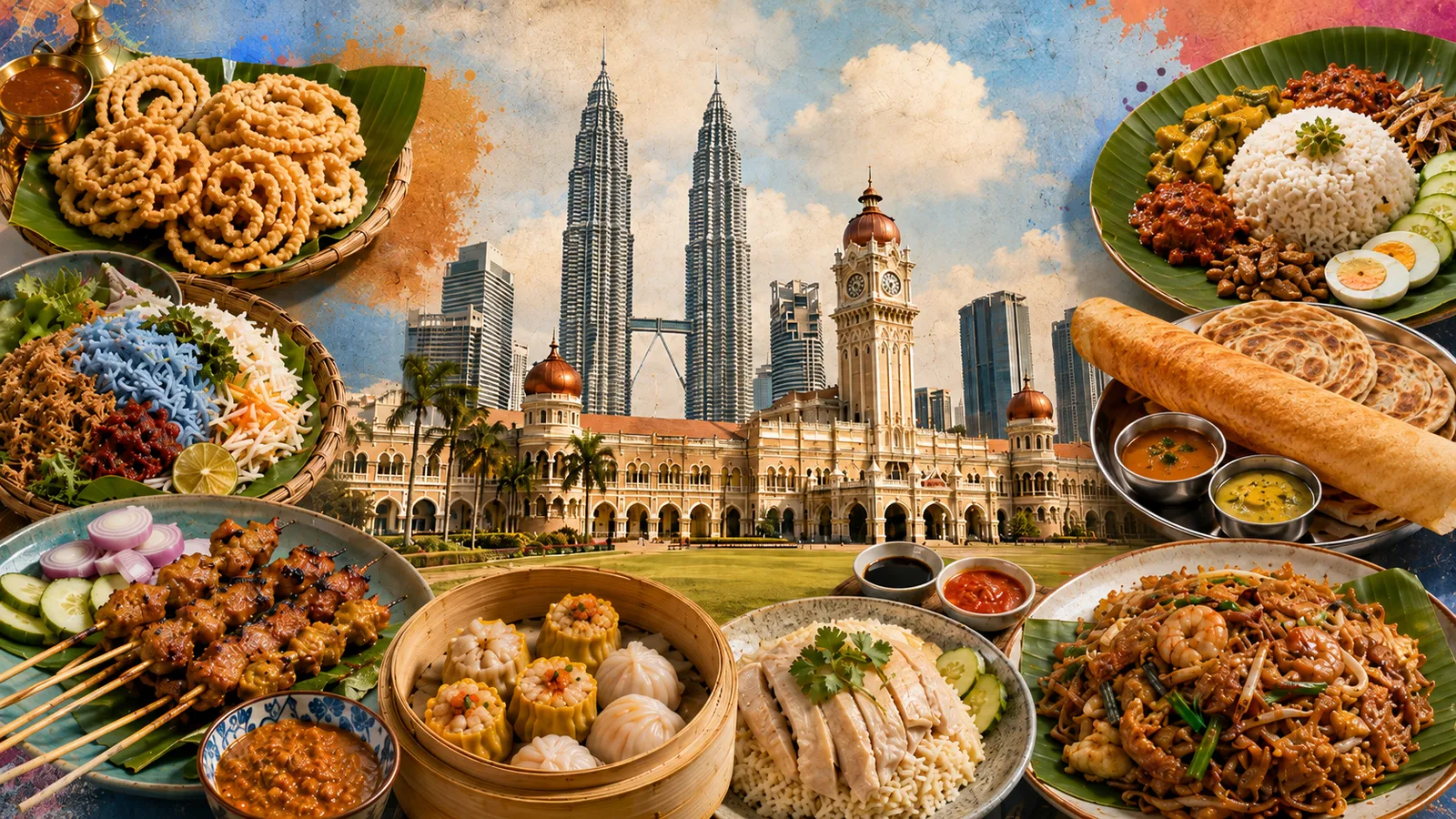
Every state has a story. Sometimes, it’s best told through food.
Behind every dish is a story of history, trade, culture and the way local communities once lived.
Look across Malaysia, and these stories begin to form familiar patterns, dishes shaped by trade, born out of resourcefulness, carried through migration, or created from what the land itself had to offer.
This Merdeka, let’s explore Malaysia through these four stories and discover what they reveal about who we are.
Born From Trade
Some dishes exist because people were always moving and their food travelled with them.
1.Terengganu (Nasi Dagang)
Nasi dagang is a traditional East Coast dish long associated with traders and travellers.
Its combination of coconut-infused rice and rich tuna curry made it filling, practical and well suited for people on the move.
Over time, it became one of the East Coast’s most recognisable breakfast dishes.
2.Johor (Kacang Pool)
Kacang Pool is an iconic Johor Bahru dish believed to have been influenced by Middle Eastern fava bean dishes.
The Johor version evolved to suit local tastes, combining a thick broad-bean stew with minced meat, egg and toasted bread.
This reflects the different cultures that have shaped Johor’s food identity.
3.Penang (Char Kway Teow)
Char kway teow grew out of Penang’s vibrant street-food scene and Chinese hawker traditions.
Flat rice noodles are stir-fried quickly over intense heat, creating the smoky aroma known as wok hei.
Over time, the dish became one of the foods most closely associated with Penang’s famous hawker culture.
Born From Resourcefulness
Other dishes tell the story of communities making the most of what was already around them.
1.Kedah (Gulai Umbut Pisang)
Gulai umbut pisang has its roots in Kedah’s rural communities, where families traditionally relied on crops and produce grown close to home.
Banana pith is cooked with coconut milk and spices, reflecting how earlier generations found creative ways to use ingredients that were readily available.
Today, the dish remains closely tied to Kedah’s agricultural roots and kampung life.
2.Pahang (Gulai Tempoyak Ikan Patin)
Gulai tempoyak ikan patin reflects how communities in Pahang made use of two important local resources which are durian and freshwater fish.
Tempoyak developed as a traditional way of preserving durian flesh through fermentation, while ikan patin has long been an important river fish in the state.
Together, they became one of Pahang’s most distinctive flavour combinations.
Born From Migration
Some dishes took root because communities settled somewhere new, bringing their food traditions with them.
1.Melaka (Hainanese Chicken Rice Balls)
Chicken rice balls are one of Melaka’s most recognisable versions of Hainanese chicken rice.
Unlike regular chicken rice, the rice is compressed and shaped into small balls before being served with chicken.
Closely tied to Melaka’s Hainanese Chinese food culture, the dish has since become one of the city’s culinary icons.
2.Sarawak (Kolo Mee)
Kolo mee developed from Sarawak’s Chinese coffee-shop culture, particularly in Kuching.
These dry-tossed noodles gradually became part of everyday local life, commonly enjoyed for breakfast or lunch.
Today, kolo mee is more than a popular meal, it is part of Sarawak’s food identity.
3.Negeri Sembilan (Masak Lemak Cili Api)
Rich coconut milk, turmeric and bird’s eye chillies give Negeri Sembilan’s masak lemak cili api its unmistakable character.
The dish is closely connected to the state’s Minangkabau heritage, shaped over centuries through migration and cultural ties with communities from Sumatra.
Born From The Land
And some dishes are shaped by the place itself, its rivers, herbs, crops and coastline.
1.Perlis (Laksa Perlis)
Laksa Perlis is known for its rich yet relatively light fish-based gravy, usually made with mackerel or similar local fish, together with torch ginger and Vietnamese coriander.
Also known as “Laksa Kola”, it is sometimes enjoyed with pulut udang or kuih spera, an unusual pairing that gives the dish a character difficult to find elsewhere.
2.Perak (Ipoh Chicken Rice)
When people think of Ipoh, tender chicken and crunchy bean sprouts are hard to separate.
Ipoh chicken rice is commonly served with steamed or poached chicken alongside the city’s famous bean sprouts, whose distinctive quality is often associated with the area’s mineral-rich water.
3.Kelantan (Nasi Kerabu)
Nasi kerabu is deeply rooted in Kelantanese food traditions, particularly through its use of fresh herbs, budu and locally available ingredients.
Its signature blue rice is traditionally coloured using butterfly pea flowers, making it instantly recognisable and reflecting Kelantan’s close connection to village life and local produce.
4.Sabah (Hinava)
Hinava is one of the traditional dishes most closely associated with Sabah’s Kadazan-Dusun community.
Fresh raw fish is mixed with lime juice, ginger, chilli and other ingredients to create its distinctive bright and tangy flavour, reflecting the diverse food traditions of Sabah’s indigenous communities.
5.Labuan (Ambuyat)
Ambuyat is a traditional dish closely associated with Labuan and reflects the territory’s cultural links with Brunei and the wider Borneo region.
Made from sago starch, it has long been part of communal dining traditions, shaped by Labuan’s position between Sabah, Sarawak and Brunei.
One Dish, All Four Stories
Nasi lemak brings together ingredients deeply rooted in Malaysian food culture.
Fragrant coconut milk, local produce, sambal refined through generations and influences that have travelled across communities and evolved along the way.
Once commonly associated with breakfast, it has grown into an all-day favourite enjoyed across different communities, from humble roadside stalls to contemporary restaurants.
Perhaps that is exactly why it has become one of the foods most closely associated with Malaysian identity itself.
One Country, Many Flavours
That is what makes Malaysian food special.
Trade, resourcefulness, migration and the land shaped different places in different ways, and every state turned those influences into something of its own.
Merdeka does not mean everyone has to be the same.
Malaysia’s identity is built from many different stories, cultures and traditions that continue to thrive in their own ways, while still finding a place at the same table.