
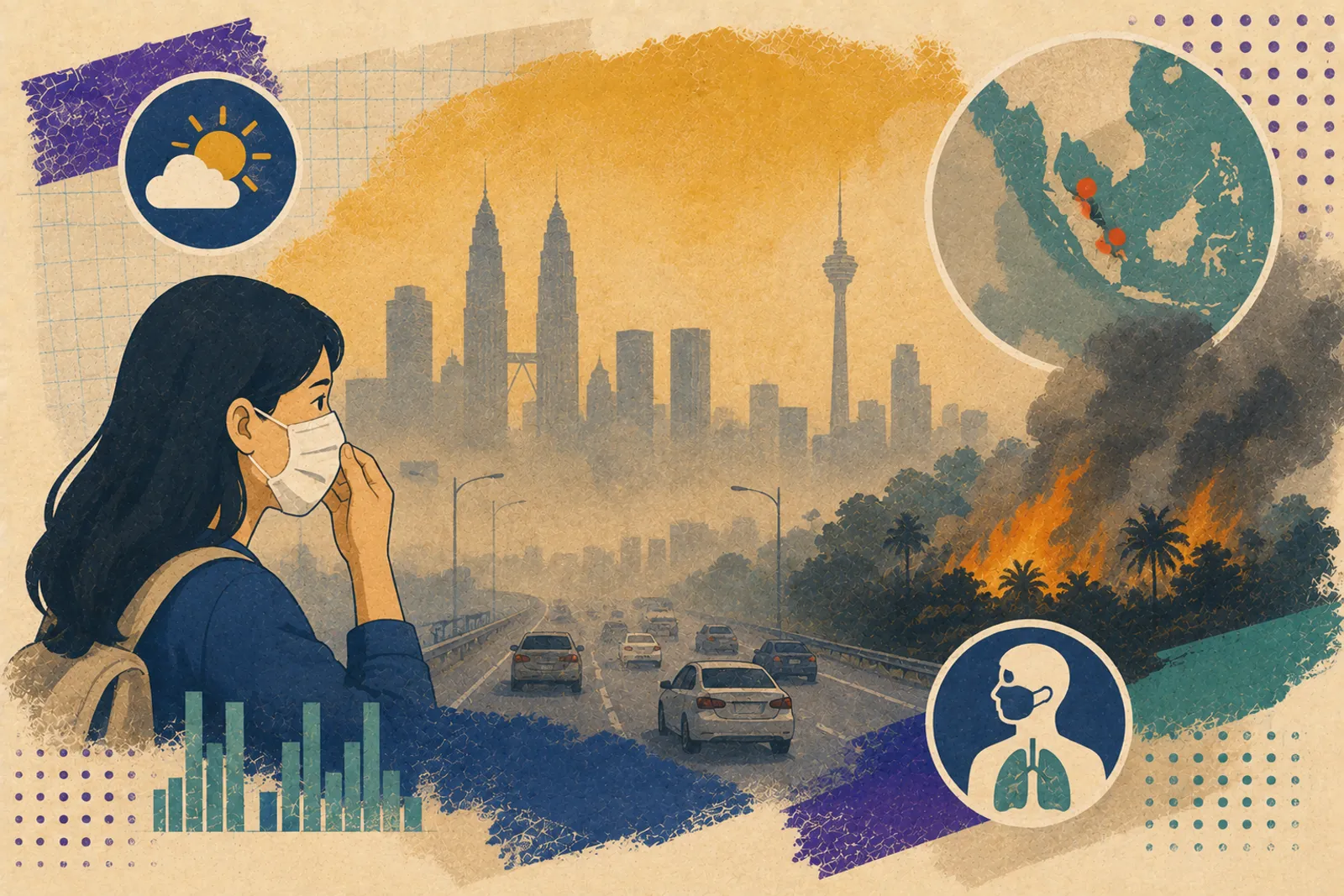
If Kuala Lumpur’s skyline has looked unusually grey lately, you’re not imagining it.
The haze, or jerebu, is back and air quality has deteriorated enough in some parts of Malaysia for authorities to restrict outdoor activities.
But what exactly is causing it, why does the Klang Valley get affected and how worried should we actually be?
Unhealthy Air Quality in Klang Valley
Air quality readings in parts of the Klang Valley have climbed into the unhealthy range, with some areas recording API readings around 150.
In Malaysia, an API reading of 101–200 is classified as unhealthy, particularly for sensitive groups such as children, older people, pregnant women and those with heart or lung conditions.
At these levels, authorities advise reducing prolonged outdoor activities.
The haze has also reduced visibility across parts of the Klang Valley, turning familiar city landmarks into blurry silhouettes from a distance.
And it isn't just a Klang Valley problem. Poor air quality has been recorded in several parts of the country, while schools in affected areas have taken precautions when readings rise.
Why Is The Haze Happening?
A major source of the smoke is forest and peatland fires in Indonesia. During dry periods, fires can spread more easily, while smoke and fine particles can travel across national borders.
This is where weather conditions become important.
MET Malaysia has warned that El Niño is expected to influence Malaysia's weather in 2026, bringing hotter and drier conditions, particularly during the Southwest Monsoon. T
The department has specifically linked these conditions to an increased risk of forest, peat fires and haze.
In other words, El Niño doesn't simply "create" the haze.
Instead, hotter and drier conditions can create a more favourable environment for fires to start, spread and burn for longer.
Once those fires produce smoke, prevailing winds can carry the pollution across the region.
That is why haze is known as a transboundary environmental problem, the fire may be across the border, but the air pollution doesn't stop at the border.
Is The Haze Actually Dangerous?
It can be…especially if you're exposed for long periods.
Haze contains tiny airborne particles, including fine particulate matter, that can be inhaled deep into the respiratory system.
That's why the API isn't simply a number telling you whether the sky looks clear. It is designed to communicate air quality and its potential impact on human health.
When API levels rise above 100, people in sensitive groups are advised to reduce prolonged outdoor activity. At higher levels, restrictions become more serious.
So if your eyes are stinging, your throat feels irritated or you're coughing more than usual, the haze isn't just something you can see.
You're breathing it in.
Why are schools changing outdoor activities?
This is one of the most immediate effects of worsening air quality.
When API levels become unhealthy, schools and other organisations may limit outdoor activities to reduce children's exposure to polluted air.
That matters because children spend a significant amount of time outdoors at school — during physical education, assemblies, sports and other activities.
For authorities, cancelling an outdoor activity is therefore a relatively simple way to reduce exposure while air quality is poor.
Why Does Malaysia Keep Dealing With This?
Because haze isn't caused by just one thing.
There are the fires themselves, including fires associated with land and peatland burning. Then there are weather conditions that determine how easily those fires spread and where the resulting smoke travels.
And because some of the fires occur outside Malaysia, the country has limited control over the original source of the pollution.
That makes haze particularly complicated.
Malaysia can monitor hotspots, restrict open burning, issue health advisories and coordinate firefighting efforts. But it cannot simply switch off a fire happening across the border.
This is why haze has become a recurring example of how environmental problems in Southeast Asia are interconnected.
A fire in one country can become a breathing problem in another.
3 Words of the Day!
1. Transboundary
Something that crosses or extends beyond national borders.
Example: "Haze is a transboundary problem because smoke can travel from one country to another."
2. Particulate
Tiny particles suspended in the air, some of which can be harmful when inhaled.
Example: "Fine particulate matter in haze can penetrate deep into the lungs."
3. Mitigate
To reduce the severity or impact of something.
Example: "Authorities are taking steps to mitigate the health effects of the haze."